+ 49-234-32-29051
  • Home
    • Conferences
    • Staff
    • Openings
    • Research groups
    • Projects
    • Dissertations
    • Erasmus
    • Lectures
    • Schedule
    • Exams
    • B.Sc. & M.Sc. Thesis

SFB 1683

What is being researched in the project?

And how is it being carried out?


more...

What is Computational Mechanics?

What makes Computational Mechanics so interesting?

And why do we all encounter it in everyday life?


more...

News

Open access: New FE-formulation for chemo-mechano-thermodynamical contact

11.10.2026


'A coupled finite element formulation for chemo-mechano-thermodynamical contact and its application to bonding and debonding' is an open access article by Prof. Sauer. The paper has been published in Computer Methods in Applied Mechanics and Engineering (Elsevier).

Abstract:
This work presents a finite element formulation for coupled chemo-mechano-thermodynamical large deformation contact. The formulation is based on the contact theory of Sauer et al. (2022) that contains six coupled (but separate) fields: the deformation and temperature of the two contacting bodies, as well as an interfacial bonding field and interfacial temperature. The latter is governed by the chemical and mechanical energy dissipation at the interface. Here the focus is placed on the evolution of bonding and debonding, and how it is coupled to the mechanical and thermal contact state. Several elementary models are proposed for this based on a quadratic contact potential. The resulting contact formulation becomes very general and versatile, which is illustrated by several challenging examples. They include pressure- and gap-dependent bonding, exothermic bonding reactions, thermal hardening and thermal expansion, as well as simultaneous bonding and debonding. They are based on a monolithic finite element implementation using classical and isogeometric shape functions together with implicit time integration. Its full linearization, required for the Newton–Raphson solution method, is also provided for the six-field problem, as well as for several of its simplifications. If bonding sites are material points, the bonding variable can be condensed-out locally.

Read the full article here:
read more
New paper is available online now

06.10.2026


The article 'Geometrically-informed generative adversarial networks as Newton–Raphson initializers for closest point projection in point-to-surface contact', written by Ankit, Deep Haloi, Saurav Sukla Baidya, Roger Andrew Sauer, Sachin Singh Gautam, has been published in Elsevier's 'Computer Methods in Applied Mechanics and Engineering'.

Abstract:
The local closest-point projection (CPP) step in quadrature point-to-surface and node-to-surface contact formulations requires nested Newton–Raphson (NR) iterations to determine the parametric coordinates of a slave point on the master surface, and constitutes a recurring computational cost in large-scale contact simulations. This work investigates the use of conditional Generative Adversarial Networks (GANs) to accelerate CPP computation on quadrilateral master surface patches, both as direct surrogates and as geometry-informed initializers within a GAN-NR hybrid strategy. Three conditional GAN variants are developed and compared: a conditional GAN (cGAN), a conditional Wasserstein GAN with gradient penalty (cWGAN-GP), and a novel Geometrically Informed GAN (GI-GAN), which embeds isoparametric surface-consistency and tangential orthogonality constraints directly into the generator objective. Trained on a modest dataset of high-fidelity NR-computed CPP solutions on bilinear quadrilateral (Q4) patches, the models are evaluated through aggregate relative error, kernel density estimation, SHAP-based interpretability analysis, regime-wise boundary sensitivity, and computational efficiency metrics.

GI-GAN consistently achieves the lowest aggregate relative error (Erel≈0.123–0.149), the closest distributional agreement with the NR reference, and the most faithful preservation of geometric feature influence as confirmed by SHAP attribution. In direct CPP mode, cWGAN-GP and GI-GAN yield one to two orders of magnitude acceleration over the conventional NR solver, with GI-GAN attaining a peak speed-up of 57.766 times. In the GAN-NR hybrid strategy, the GAN prediction serves exclusively as an improved initial guess, and the hybrid solution is identical in accuracy to the conventional NR procedure. GI-GAN achieves a consistent 19%–21% reduction in total wall-clock time and approximately 37%–38% reduction in NR iterations across all tested sample sizes, at no additional approximation cost. Robustness of the hybrid strategy is further validated on a range of benchmarks. These include controlled edge-to-edge and corner-to-corner benchmarks with varying fractions of boundary-dominated CPP cases, and a connected piecewise bilinear multi-element surface. Curved-surface benchmarks using serendipity quadrilateral (Q8) elements are also considered, covering a half-cylinder, a sinusoidally modulated tubular surface, and a self-contact-inspired wavy tubular shell. All benchmarks yield strictly positive computational gains. Notably, the Q4-trained GI-GAN transfers directly to Q8 curved geometries without retraining, demonstrating robustness beyond its training domain.

Before November 26, 2026 this share link provides a 50 days' free access to the article:
read more
Lecture Dates WS 2026/2027

05.10.2026


The lecture dates for the winter term 2026/2027 are online:
read more
New open access article

16.09.2026


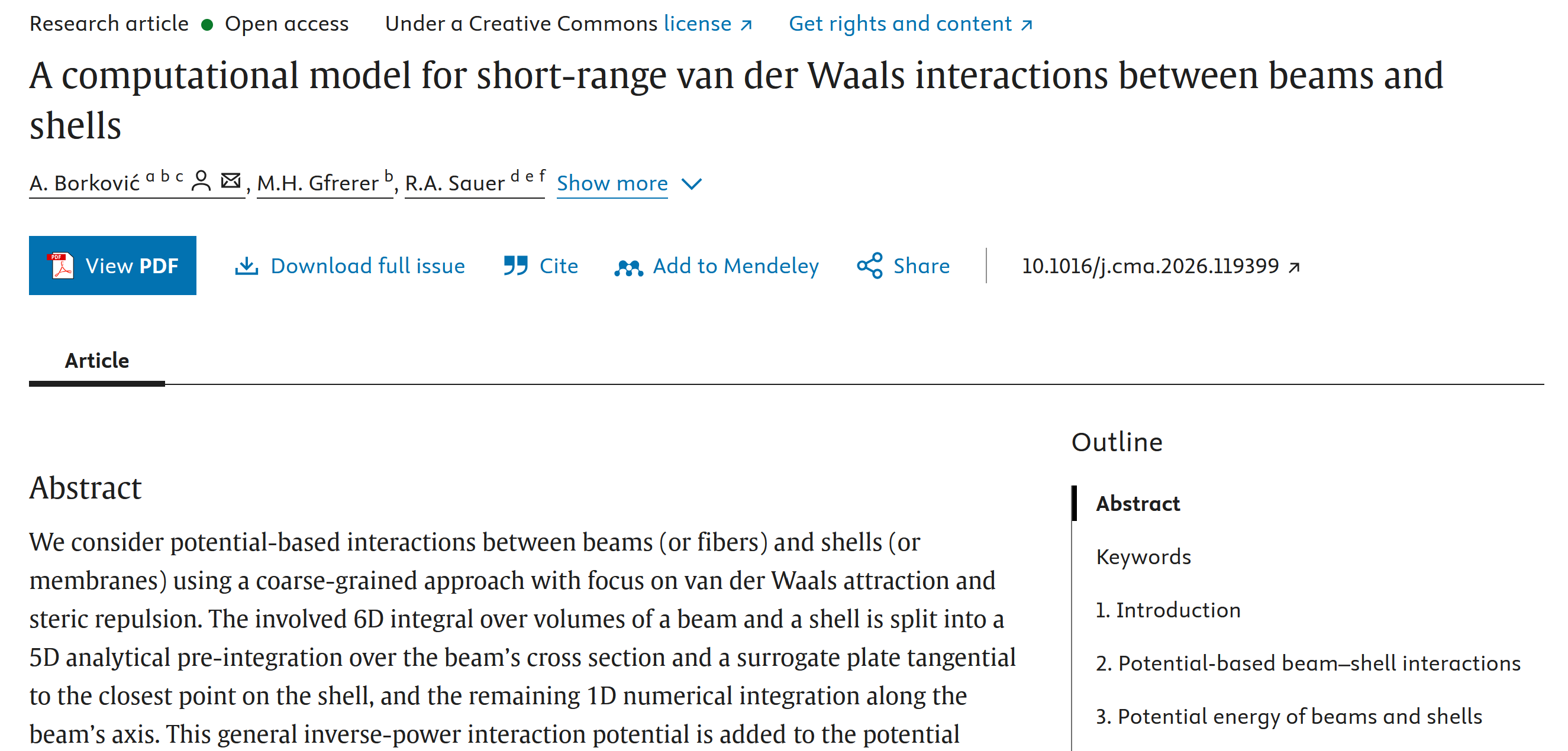
The article 'A computational model for short-range van der Waals interactions between beams and shells' written by A. Borković, M.H. Gfrerer, R.A. Sauer has been published in 'Computer Methods in Applied Mechanics and Engineering' by Elsevier.

Abstract
We consider potential-based interactions between beams (or fibers) and shells (or membranes) using a coarse-grained approach with focus on van der Waals attraction and steric repulsion. The involved 6D integral over volumes of a beam and a shell is split into a 5D analytical pre-integration over the beam’s cross section and a surrogate plate tangential to the closest point on the shell, and the remaining 1D numerical integration along the beam’s axis. This general inverse-power interaction potential is added to the potential energies of the Bernoulli–Euler beam and the Kirchhoff–Love shell. The total potential energy is spatially discretized using isogeometric finite elements, and the nonlinear weak form of quasi-static equilibrium is solved using the continuation method. We provide error estimates and convergence analysis, together with two intriguing numerical examples. The developed approach provides excellent balance between accuracy and efficiency for small separations.

Read the open access article here:
read more
Doctoral Defense by Giao Vu

14.08.2026


On Friday, 14 August 2026, at 2:00 PM Giao Vu gave her PhD defense, titled 'A Virtual Coda Wave Interferometry Laboratory for Damage Assessment in Reinforced Concrete Structures'.

Vu.png" width="500" height="600">

Dear Giao, congratulations on defending your PhD successfully! We wish you great success in your future ahead!

Abstract:
Concrete infrastructure ages long before it fails visibly. Detecting that deterioration early – while repairs are still cheap – is one of the central challenges in structural health monitoring. Coda Wave Interferometry (CWI) offers a promising solution by exploiting the late-arriving portion of ultrasonic measurements. Having travelled repeatedly through the material, these waves sample a far larger volume than conventional methods and are sensitive to microstructural change. Embedded ultrasonic sensors are inexpensive, making CWI an attractive basis for permanent monitoring systems. The obstacle is interpretation: a measured signal change tells us that something has happened inside the concrete, but not what, where, or how severe.

This thesis closes that gap with a virtual CWI laboratory. Meso-scale models simulate the cracking process and the ultrasonic waves travelling through it, linking a structure‘s internal state directly to its measured response. The framework was validated against real experiments from material specimens up to reinforced concrete beams, across varying mixtures, structural layouts, and sensor configurations.

The result is a quantitative map from velocity change to what engineers care about: crack width, reinforcement strain, stiffness degradation. The synthetic data then trained a transformer-based classifier which, after domain adaptation, predict damage states from real measurements with good accuracy.

Together, the framework provides scalable tool for designing sensor networks, generating validated training data, and translating monitoring signals into decisions.
read more
MORE NEWS

Research

Our research activities can be integrated into these three categories

Structural Intelligence and Reliability
Polymorphic Uncertainty Modelling, Reliability Analysis of Structures, Numerical Surrogate Models, Real-Time Simulation, Optimization of Structures and Processes
Scale-bridging Structural Analysis
Multiscale Modelling of Concrete Durability and Deterioration under Combined Loads, Modelling of Fracture and Damage in Quasi-brittle Materials, Additive Manufacturing of Concrete Structures, Data-driven Material Design
Subsurface Structures
Numerical Simulation in Mechanized Tunneling, Ground Models and Soil Freezing, Safety Assessment of Underground Structures, Safety Assessment of Underground Structures, Simulation Models for Excavation and Material Transport

Research projects

Modular Reuse – SFB 1683
Advanced Simulation Framework
Real-time Prediction of Thin Shell Deformations
Further Projects

Teaching

Information about our courses, available bachelor and master theses as well as other interesting offers for students
Erasmus+ Program
Schedule
Bachelor & Master Thesis
Lectures

INSTITUTE IN NUMBERS

587

Publications

26

Dissertations

254

Master

129

Bachelor

Contact

Ruhr University Bochum, Institute for Structural Mechanics, IC 6/185, Universitätsstraße 150, 44801 Bochum
+ 49 234 32 - 29051
sd@rub.de
Message

Privacy Notice